
November 17, 2026
A visible crack is a reason to assess the concrete, not proof that the whole slab needs replacing. For cracked concrete repair commercial Auckland properties need a response based on the crack’s movement, location and effect on site operations. A widening crack, uneven surface or water ingress warrants prompt attention, especially where people, forklifts or deliveries use the area.
It’s understandable to want a clear plan without disrupting staff, tenants, customers or access. This guide explains what changes to look for, how a repair scope is developed and how to plan work around your site. The right approach depends on the concrete’s condition and how the area is used, rather than a one-size-fits-all fix.
Service King Commercial includes concrete concerns within its Building Repair and Maintenance service. A Free site assessment helps establish the site conditions, followed by a detailed, itemised proposal for the work. This gives you a practical starting point for deciding what needs attention and coordinating a response across your Auckland property.
Key Takeaways
- A crack’s appearance alone can’t show its cause or the right repair. Look for changes in width, level, moisture or surrounding concrete.
- For cracked concrete repair commercial Auckland properties need, the assessment should consider crack behaviour, site use and operational impact rather than assume one fix suits every crack.
- Make the area safe, take photographs from consistent viewpoints and record when changes appear. Note how staff, customers, vehicles or equipment use the space.
- A site-specific assessment can help define a suitable repair scope and plan work around property operations. Review the proposal before arranging the response.
Table of Contents
- Cracked concrete at an Auckland commercial property: what the signs can tell you
- How commercial concrete cracks develop and how repair methods differ
- A practical Auckland commercial process for documenting and prioritising cracked concrete
- Arrange commercial cracked concrete repair in Auckland with a site-specific scope
Cracked concrete at an Auckland commercial property: what the signs can tell you
Commercial concrete repair involves assessing and addressing cracks in slabs and other concrete building surfaces. An initial assessment should not rely on appearance alone. A fine line may remain stable, while a similar-looking crack elsewhere may relate to movement, water or loading. Its direction and location, the surrounding surface and any changes over time all help build a clearer picture.
For cracked concrete repair commercial Auckland sites need, the practical question is also how the area functions. A surface in a rarely used service area has a different operational impact from one across an entrance, shared accessway or loading area. Consider who uses it and whether a change could affect safe movement or daily work.
Which crack changes deserve prompt attention?
Record whether a crack appears to be widening or lengthening, whether its edges have become uneven, and whether nearby concrete is breaking away. Note recurring damage after previous repairs, too. These observations don’t establish the cause, but they help an assessor understand how the surface is changing.
Prioritise assessment where a crack creates an uneven route for staff, tenants or visitors, or interferes with access and site activity. A single width measurement can’t confirm structural damage or determine the repair. It needs to be considered alongside visible movement, the concrete’s condition and the area’s use.
Why Auckland site conditions belong in the assessment
Rainfall and water movement around a slab can be relevant, as can ground movement, repeated loading and how the concrete was constructed. These are factors to investigate, not proof of a particular cause. For example, an assessor may consider drainage and vehicle use around a loading area, or water entry near a shared entrance. Background on concrete degradation mechanisms explains how physical and chemical processes can affect concrete over time.
Record what you can see and where it occurs. A site-specific assessment connects those observations with the condition and use of the area, helping shape a repair scope around the property rather than an assumed fix.
How commercial concrete cracks develop and how repair methods differ
Cracks can form for several reasons. Concrete may shrink as it cures, or movement in the ground or slab may place stress on it. Water can enter and affect the surrounding material. Repeated vehicle or equipment loading may contribute, while construction details such as joints can influence where cracks appear. More than one factor may be involved.
Similar-looking cracks can therefore call for different responses. For cracked concrete repair commercial Auckland projects, the scope needs to reflect the crack’s behaviour, the surrounding concrete and the site’s use. Guidance on standards for concrete repair and protection provides a New Zealand reference for inspection and repair considerations.
What an assessment needs to establish
Record the crack’s location and pattern, its visible changes, and its relationship to joints, edges and nearby surfaces. Note whether the slab is uneven, breaking up or affected by water. These are observations, not proof of the underlying cause. Keeping evidence separate from assumptions helps shape a scope around what can be seen and what needs further assessment.
Why repair selection is not one-size-fits-all
Broad repair categories include sealing or filling surface cracks, injection for cracks that need treatment within the concrete, resurfacing worn areas and slab-level work where the level or support is part of the issue. These are possible considerations, not a prescribed method. A surface treatment may not address ongoing movement or a deeper issue. A crack alone also doesn’t mean the slab must be replaced.
- Stable surface crack: assess whether a local surface treatment is suitable.
- Changing or water-affected crack: investigate movement and water entry before selecting a response.
- Uneven or breaking-up concrete: assess the surrounding slab and how the area is used.
- Crack near a joint or heavily used route: consider traffic, access and the condition of the adjoining concrete.
Service King Commercial can assess concrete concerns as part of its commercial building repair and maintenance service. Arrange a site-specific concrete repair assessment to develop a scope that reflects the site conditions and operational needs.
A practical Auckland commercial process for documenting and prioritising cracked concrete
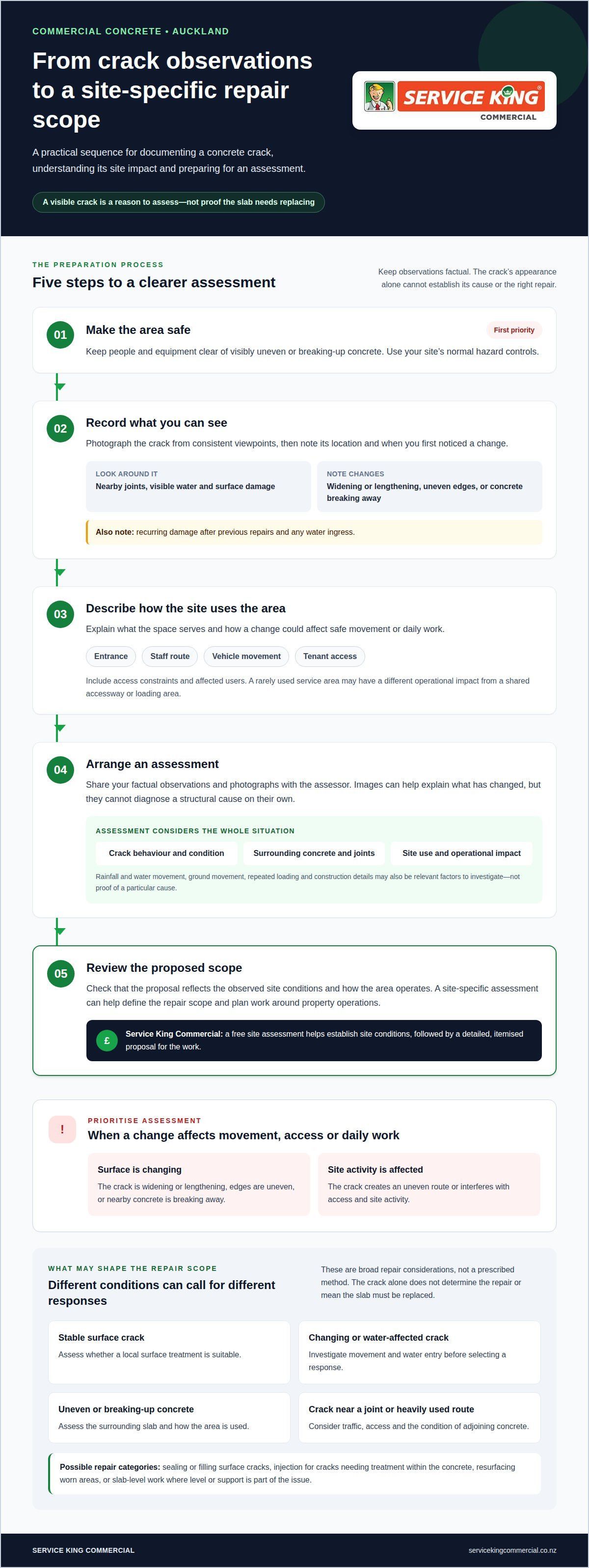
A clear record helps an assessor understand what has changed and how the affected area supports site operations. Use this sequence to prepare for an assessment:
- Make the area safe. Keep people and equipment clear of visibly uneven or breaking-up concrete. Use your site’s normal hazard controls.
- Record observations. Photograph the crack from consistent viewpoints. Note its location, nearby joints, visible water or surface damage, and when you first noticed a change.
- Note site use. Describe whether the area serves an entrance, staff route, vehicle movement or tenant access. Include access constraints and affected users.
- Arrange an assessment. Share the factual observations and photographs. Don’t use images alone to diagnose a structural cause.
- Review the scope. Check that the proposed work addresses the observed condition and considers how the site will operate during the work.
What to document before arranging an assessment
Keep notes specific and factual. Record whether the crack appears to have lengthened or widened, whether its edges look uneven, and whether water or surface damage is present. Note nearby joints and any recurring damage. Avoid assigning a cause based on appearance alone. If movement, unevenness or recurring break-up is present, don’t attempt a DIY repair that could mask the change.
How to reduce disruption while planning work
Identify busy access points, delivery movements and people who may be affected. Share operating periods and access limits when arranging the assessment. This gives the work scope a practical basis for sequencing and communication, without assuming a fixed duration. For related exterior considerations, the Auckland commercial exterior building maintenance guide provides useful context. Technical guidance such as the American Concrete Institute’s epoxy injection repair procedures is not a substitute for assessing the site condition.
For a site-specific starting point, arrange a commercial concrete assessment with Service King Commercial.
Arrange commercial cracked concrete repair in Auckland with a site-specific scope
Cracked concrete needs a response based on the affected area and how the property operates. Service King Commercial’s Building Repair and Maintenance service can assess the site issue and develop a tailored scope. The work should be defined by the observed condition and practical requirements, rather than by assuming a repair method before the assessment.
What to expect from the initial site assessment
The assessment considers the affected concrete, its visible condition, site use and practical access requirements. Share photographs and notes about changes, access routes or users who may be affected. This helps build an understanding of the issue in its commercial setting. Prospective clients can arrange a Free site assessment , followed by a detailed, itemised proposal that sets out a scope suited to the property.
Where the concrete concern sits alongside other building work, the proposal can clarify how repair requirements fit the wider maintenance plan, including related commercial trade services in Auckland.
Coordinate the next step for your Auckland property
Practical planning matters on a working site. Service King Commercial’s teams are located across Auckland, and in-house management supports communication, quality control and issue resolution. Service delivery is Fully insured and highlights Health & Safety Compliance . These arrangements support clear coordination as the scope is considered and the next steps are planned.
For properties with related facility needs, Service King Commercial’s Integrated Facility & Maintenance Service can connect repair and maintenance requirements within a broader support approach. Service King Commercial is A one-stop facility services partner for Auckland commercial properties.
Request a Free site assessment from Service King Commercial to discuss the cracked concrete at your property and receive an itemised scope for consideration.
Make a clear next move for your site
A crack can be easy to put off when the cause is unclear and repairs could affect daily operations. The useful next step is to turn uncertainty into a site-specific decision. With cracked concrete repair commercial Auckland properties can plan around the affected area, its use and the proposed work scope, rather than committing to an assumed fix.
Keep the issue visible in your property maintenance planning. Share what has changed and how the area is used, then use the assessment and proposed scope to decide how to proceed. That gives your team a practical basis for coordinating access and communicating with the people who use the site.
Service King Commercial provides commercial building repair and maintenance for Auckland properties. Arrange an assessment for your commercial concrete concern and take the next step with a site-specific plan.
Frequently Asked Questions
How much does cracked concrete repair cost for a commercial property in Auckland?
The cost depends on the site assessment and the repair requirements, so a project-specific scope is needed before costs can be set out. Service King offers prospective clients a Free site assessment and a detailed, itemised proposal. To help define the work, provide the property location, describe the affected area and share any records of changes or operational constraints.
Can a commercial site keep operating while cracked concrete is being repaired?
Whether the site can keep operating depends on the affected area, access needs and how the space is used. A repair near a staff entrance may need different planning from work in a storage area. Share operating constraints during the assessment, including staff, tenant and visitor access. This allows the proposed scope to account for site activity without assuming uninterrupted access or a fixed schedule.
What information should I provide when reporting cracked concrete at a commercial property?
Provide the exact site location and clear photographs that show the crack and its surroundings. Describe changes you’ve noticed and identify any affected routes, such as a vehicle entrance or shared walkway. Mention visible water or unevenness. For cracked concrete repair commercial Auckland property managers should treat these details as preparation for an in-person assessment, not as a way to diagnose structural causes from photographs.
Can cracks return after concrete has been repaired?
Cracks can recur if the underlying cause remains or conditions affecting the concrete continue. For example, ongoing movement or repeated loading may influence how the area behaves after work. If a crack reappears, record what has changed, when you noticed it and whether nearby surfaces are affected. Arrange an assessment of the current condition rather than assuming the same scope still applies.
Does every crack in a commercial concrete slab mean the whole slab needs replacing?
No. A crack by itself doesn’t show that full slab replacement is needed. The assessment considers the crack’s behaviour, the condition of nearby concrete and how the area is used. A hairline mark in a low-use area presents different information from a crack accompanied by unevenness or surface break-up. The proposed response should follow site findings, not an assumption made before inspection.
Recent Posts